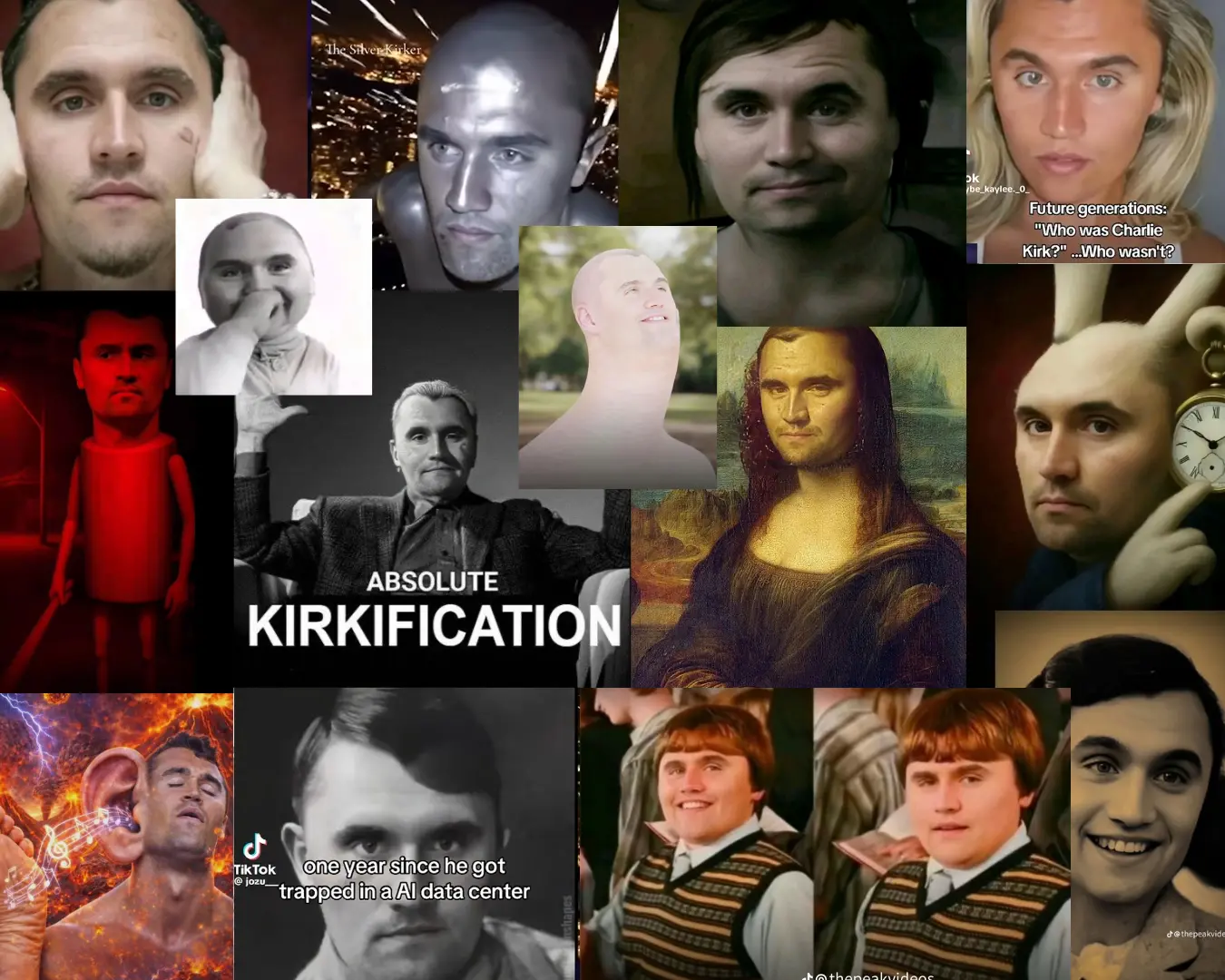
Welcome to the Kirkaverse

A case study on the fastest growing phenomenon in culture: memification.
Jackie Ouellette
·
October 1, 2026

Yes you heard that right, the 1 year anniversary of podcaster Charlie Kirk’s death is trending. But not for the reasons you might think. 

For many the anniversary has gravitated away from traditional memorial posts and somber reflections, but towards something else entirely: memes.

And not just one meme, but an entire language surrounding Charlie Kirk; including Kirkaversary, Before Kirk (BK), After Kirk (AK), Kirkification, and so on.

Representing a growing phenomenon in culture: memification. 

To fully understand the nuances of the kirk meme ecosystem, one must take a step back and fully grasp who Charlie Kirk was and the political climate of the time surrounding his assasination. 

The man behind the meme?

Charlie Kirk was best known as the founder of Turning Point USA, a conservative organization focused on spreading conservative Christian ideology amongst the youth. Quickly rising to fame as a political activist turned social media personality, known for leading provocative "prove me wrong" debates on college campuses.

Yet despite popularity, Kirk was an extremely controversial figure with extreme stances regarding polarizing issues such as abortion, gun control, civil rights including trans issues, and feminism-- just to name a few.

Creating a unique tension on how people felt about his death regardless of political affiliation, later transitioning into how the meme unfolded online. 

As his death was not only livestreamed, but shared to every corner of the internet in a matter of seconds creating a domino effect of events that followed, from conspiracy theories to pointing fingers. While the entire world watched, the lack of information quickly became a narrative war. Where absurdity came out on top as the ultimate coping mechanism. Although ill-fitted his life was incredibly online and so was his death.

The Kirkifixation of it all

His death quickly became a cultural takeover, dominating the news, our homes, and even the workplace, leaving many people unsure of how they were “supposed” to feel. Enter: the Kirk meme explosion. 

Because (shocker) people don’t like being told what to think, say, or feel, especially when it comes to something as personal as how to mourn, whether IRL or online. 

Taking part in Kirk memes became a way to take control. Not only to cope with feelings but as an act of defiance against the government. Making light of the paradox of the situation. 
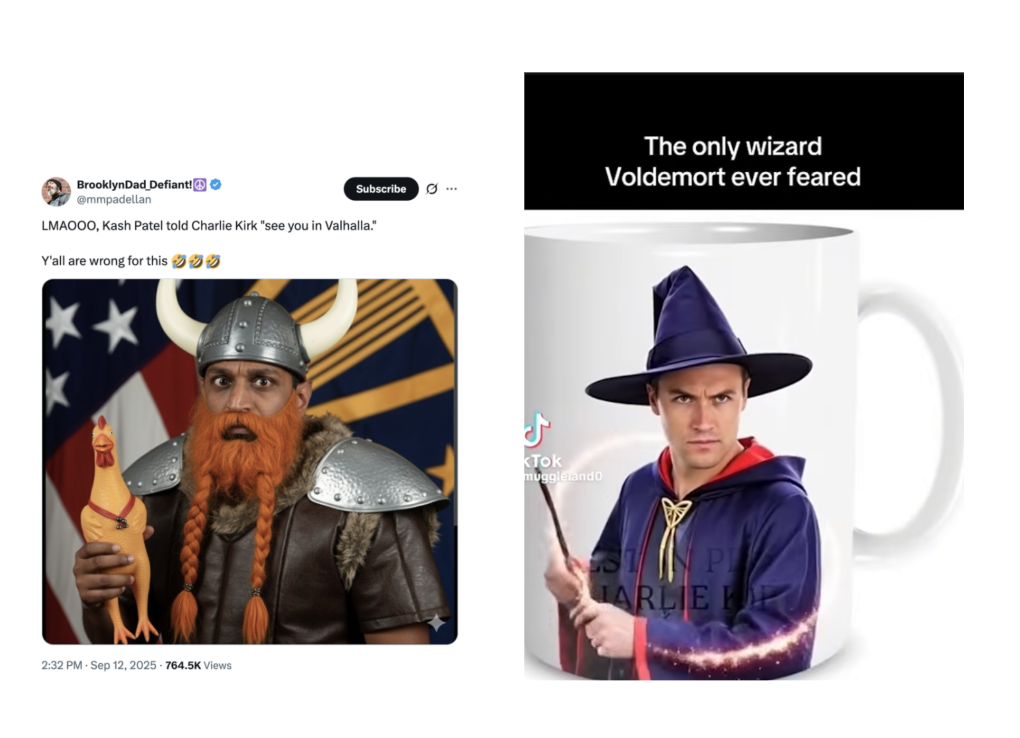
Above is an early meme that originated after Kirk’s funeral mocking government officials like FBI director Kash Patel after he compared Kirk to Vikings/ Norse gods, painting him as a saint-like martyr and magical being.  

These memes highlight the difference in tone set by politicians vs online, creating two distinct, absurd realities.

Leading us to the memeification of it all.

Memeification isn't a new concept, but this cultural phenomenon has taken on a new life in recent years. While originally intended to simplify complex ideas in the age of social media, we end up playing a societal game of telephone distorting nuanced takes. 

And in our case, with the Charlie Kirk memes evolving into its own language, ecosystem, and ultimately culture itself. Taking on a new life that has never been done before. 

I mean there has never been a meme as evolved as Charlie Kirk and it’s not stopping anytime soon (lowkirkenuinely). He has only become MORE "relevant" after his death simply because of the memeification, integrating into pop culture in a way nobody expected.

People can use the word "Kirk" with 0 association to his ideology or what he was actually known for in his lifetime. Turning the Kirkaverse into a universal outlet to cope with graphic content like death, climate change, or data centers. Evolving beyond it all, making me wonder if this is the future of memes.
Welcome to the Kirkaverse

Jackie Ouellette
·
October 4, 2026

A case study on the fastest growing phenomenon in culture: memification.

Happy Kirkaversary

Yes you heard that right, the 1 year anniversary of podcaster Charlie Kirk’s death is trending. But not for the reasons you might think. 

For many the anniversary has gravitated away from traditional memorial posts and somber reflections, but towards something else entirely: memes.

And not just one meme, but an entire language surrounding Charlie Kirk; including Kirkaversary, Before Kirk (BK), After Kirk (AK), Kirkification, and so on.

Representing a growing phenomenon in culture: memification. 

To fully understand the nuances of the kirk meme ecosystem, one must take a step back and fully grasp who Charlie Kirk was and the political climate of the time surrounding his assasination. 

The man behind the meme?

Charlie Kirk was best known as the founder of Turning Point USA, a conservative organization focused on spreading conservative Christian ideology amongst the youth. Quickly rising to fame as a political activist turned social media personality, known for leading provocative "prove me wrong" debates on college campuses.

Yet despite popularity, Kirk was an extremely controversial figure with extreme stances regarding polarizing issues such as abortion, gun control, civil rights including trans issues, and feminism-- just to name a few.

Creating a unique tension on how people felt about his death regardless of political affiliation, later transitioning into how the meme unfolded online. 

As his death was not only livestreamed, but shared to every corner of the internet in a matter of seconds creating a domino effect of events that followed, from conspiracy theories to pointing fingers. While the entire world watched, the lack of information quickly became a narrative war. Where absurdity came out on top as the ultimate coping mechanism. Although ill-fitted his life was incredibly online and so was his death.

The Kirkifixation of it all

His death quickly became a cultural takeover, dominating the news, our homes, and even the workplace, leaving many people unsure of how they were “supposed” to feel. Enter: the Kirk meme explosion. 

Because (shocker) people don’t like being told what to think, say, or feel, especially when it comes to something as personal as how to mourn, whether IRL or online. 

Taking part in Kirk memes became a way to take control. Not only to cope with feelings but as an act of defiance against the government. Making light of the paradox of the situation. 

Above is an early meme that originated after Kirk’s funeral mocking government officials like FBI director Kash Patel after he compared Kirk to Vikings/ Norse gods, painting him as a saint-like martyr and magical being.  

These memes highlight the difference in tone set by politicians vs online, creating two distinct, absurd realities.

Leading us to the memeification of it all.

Memeification isn't a new concept, but this cultural phenomenon has taken on a new life in recent years. While originally intended to simplify complex ideas in the age of social media, we end up playing a societal game of telephone distorting nuanced takes. 

And in our case, with the Charlie Kirk memes evolving into its own language, ecosystem, and ultimately culture itself. Taking on a new life that has never been done before. 

I mean there has never been a meme as evolved as Charlie Kirk and it’s not stopping anytime soon (lowkirkenuinely). He has only become MORE "relevant" after his death simply because of the memeification, integrating into pop culture in a way nobody expected.

People can use the word "Kirk" with 0 association to his ideology or what he was actually known for in his lifetime. Turning the Kirkaverse into a universal outlet to cope with graphic content like death, climate change, or data centers. Evolving beyond it all, making me wonder if this is the future of memes.

See More by

Jackie Ouellette

→