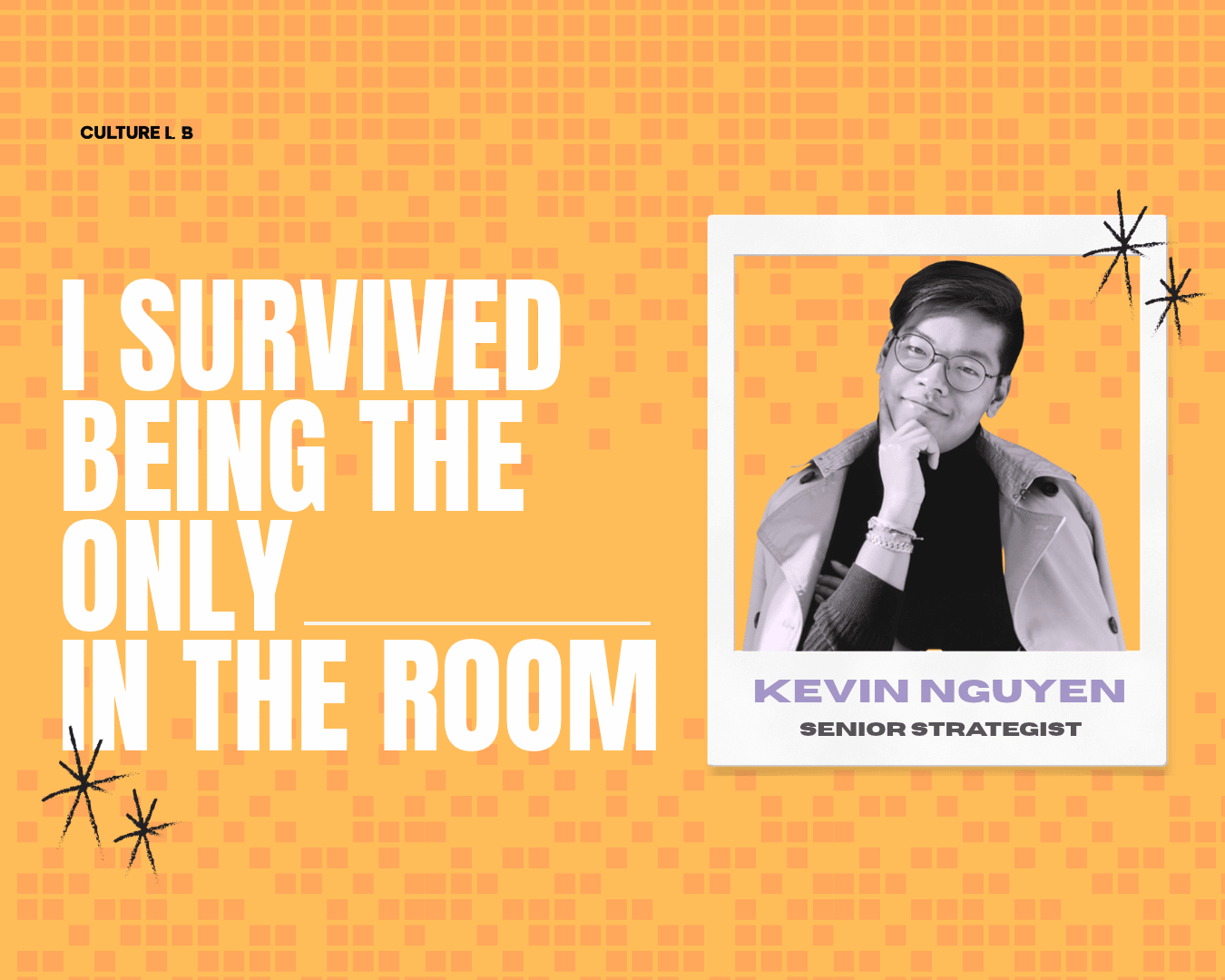



Hailing from the Brandcenter Class of 2022, Kevin Nguyen has made his way through his fair share of ad agency rooms.
With an impressive career as a strategist and awards to show for it, Kevin has the experience, the credentials, and the receipts to prove he belongs.
But even with all this under his belt, Kevin knows the little voice many of us junior strats are a bit too familiar with – “Do I even belong here?”
Now a Senior Strategist at JOAN Creative, Kevin has learned a few things about navigating the highs, lows, and uncomfortable in-betweens of being the only queer person or person of color in the room.
Especially when people seem more interested in what you represent than what you actually bring to the table.
Second-year strategist, Cliff Maske sat down with Kevin as he shared his experience with imposter syndrome, finding your people, and learning when to speak up, advocate for yourself, and absolutely own your seat at the table.
What was the challenge you were facing?
In one of my first jobs, I was invited to a room with a lot of people and asked to talk about my experiences because I brought “a unique perspective.”
Later I found out it was mostly because I was a person of color, and they were really milking it.
It felt weird because I’m like,
Shoud I talk about my experience, or do you want to see a romanticized version of that experience?
Sometimes when you're the only queer person or person of color in a room, maybe it does feel like you have to perform, and it’s not the best experience to feel that way.
Why was this a critical moment in your career or personal life as a strategist?
One thing that is so important as a strategist is that when you’re writing briefs or when you're trying to speak to an audience, so much of it comes from your personal experiences.
When you're writing something or pulling insights, so much of it is embedded in how you see the world, and you're hired for your interpretation and your perspective.
I think strategists who succeed are really good at having a sharp perspective that makes them unique. You can hear their voice in the way they write.
But when you're told to change your voice or tap into a part of your identity that isn't fully explored or that you're not ready to talk about, you can't really bring your all to that.
People want you to talk about your uniqueness and your perspective, but sometimes it's not the right time.
There's an opportunity to preserve your peace and protect it, but also use your perspective as a superpower when the time is right.
What was the hardest or most unexpected part of navigating this situation that people on the outside don't realize?
The hardest part was how much it brings out your imposter syndrome. It does feel kind of like,
Was I hired for my brain or was I hired for this reason?
When you’re the only “blank” in a room, there are a lot of times when you feel like, “Do you actually want me to work on this, or do you want me to just sign off on something so that it looks like the work was inclusive? Or am I supposed to talk about how it relates to the Asian-American experience, when in reality it doesn’t?”
Not everything fits that way, but sometimes it can feel like you’re expected to put it into your brief.
I didn't realize how much that would trigger my imposter syndrome.
The other thing I didn't really realize is how many people actually experience that.
It’s disappointing how often that comes out, but it also speaks to the importance of being socially aware and present.
When we have interns or people below me, I always make sure to give them reassurance and validation, whether it's complimenting their work or acknowledging even their smallest contributions.
It helps them build a habit of being proud of what they do and knowing their work matters.
Was there a specific moment, decision, or realization that shifted things from "crisis mode" to "management mode"?
There hasn’t been a “specific” moment, but if something feels wrong, you should 100% be vocal and speak up about it. And I think being able to do that stems from having a support system at work that makes you feel empowered to do that.
JOAN has been a really great place, but other places I've been at have made me feel like I’m having imposter syndrome.
One thing I've done is develop really personal relationships with a mentor outside of my vertical. Having an account lead or creative lead I can look up to has helped me navigate that a little bit more.
What are habits that you relied on to get to the other side?
As an introvert, one thing that I have struggled with in the past is feeling like I’m contributing to every meeting I’m in.
Am I actually present in this meeting, or am I just taking up space?
I think when you're starting out, it's okay not to speak in every meeting, but it can really stunt your growth at a certain point if you keep that habit.
If I'm in a room, obviously I was there for a reason, and I'm just making sure that I am contributing to the room that I was asked to be in.
One thing that has really helped with that is the relationships that you build outside of your vertical. One person gave me advice and said, “It's great when you form relationships with people at your tier, at your level, but you actually should be forming relationships with one level above you.”
If you're a junior, great. Have friends that are also juniors because then you have someone to talk to. But it makes it a lot easier if you find a senior or director-level person to build a relationship with.
When it comes time for them to give you advice, feedback, or even bring you onto a project, you're top of mind. And when you're presenting work, it's so much easier because you already know these people.
That has helped me tremendously with feeling present in a room because I feel like I'm in a room with friends as opposed to people that I'm very junior to.
Was there a specific soft skill that helped you through this?
Being personable.
When you're interviewing someone in a focus group or just a one-on-one interview, or when you're doing strategy research, the ability to talk to someone, especially a stranger, is a skill that a lot of people don’t have.
It’s also tremendous in the workspace because you pick up on little nuances that people don't, and you're able to adapt your deck, presentation, or brief to make an impact.
For example, a client once said, “These analogies really make it easy for me to understand.” So, every deck since then has had a comparison or analogy that breaks things down into smaller, more tangible explanations.
Just be really good at picking up on the small details.
Looking back, how did surviving this experience change how you work, lead, or approach your career today?
It's shaped the way I've led people and been a mentor. I’ve felt an obligation to advocate for them and give people validation and reassurance when I can. I was in their shoes once, so I know what it feels like.
I make it a point to compliment my team as much as I can, just to make sure they don't ever feel like they don't belong somewhere.
I've also had an obligation to advocate for myself.
In this industry, if you're not advocating for yourself, people are going to just think that you're okay with being stagnant.
It was a massive relearn because I took a break from the industry for a minute, but in advertising, where things are not so predictable, you have to be the one that fights for yourself.
Whatever your goal may be, every step you take has to move you toward that long-term goal. Make sure those moves are being acknowledged, and if people aren't seeing or hearing about them, bring them up on your own.
What is one piece of advice you would give to new strategists about to face their first major industry storm?
I think that if you're starting your career and looking for a job or an internship,
Don't chase the name on the door, but always chase the people.
It's perfectly valid to reach out to Brandcenter alumni or people you think are cool on LinkedIn and say, “Hi, I'm so-and-so, and I'm applying for a job here. I'd love to connect to learn more about your experience.”
The people you work with day to day will really shape whether you like the culture there. If your manager isn't supportive or it's very cliquey, you're not going to like your first job, especially if you're only chasing the brand on the door for a resume booster.
I've left agencies to follow the people I wanted to work under, too. More than once, when someone left an agency because I was learning from them, I went with them. I'll be like, “When there's a new opportunity, take me with you,” and then they will take me with them.
That’s what led me to JOAN. My mentor that I've been learning from for the past five years is here. That made a really big impact on how quickly I adjusted to the culture because I already knew people.
The same happened at Terri and Sandy. I had someone I looked up to whose career I really admired, and he was the reason I wanted to work there.
I think that's an important thing: not to look for these massive agencies, but to look for the people you feel like you can learn a lot from.
If you're already in your career and have a pitch, briefing, or presentation with someone way more senior than you, and you're feeling nervousness or doubt,
You deserve to be in the room as much as anyone.
*Q+A edited for length and clarity.