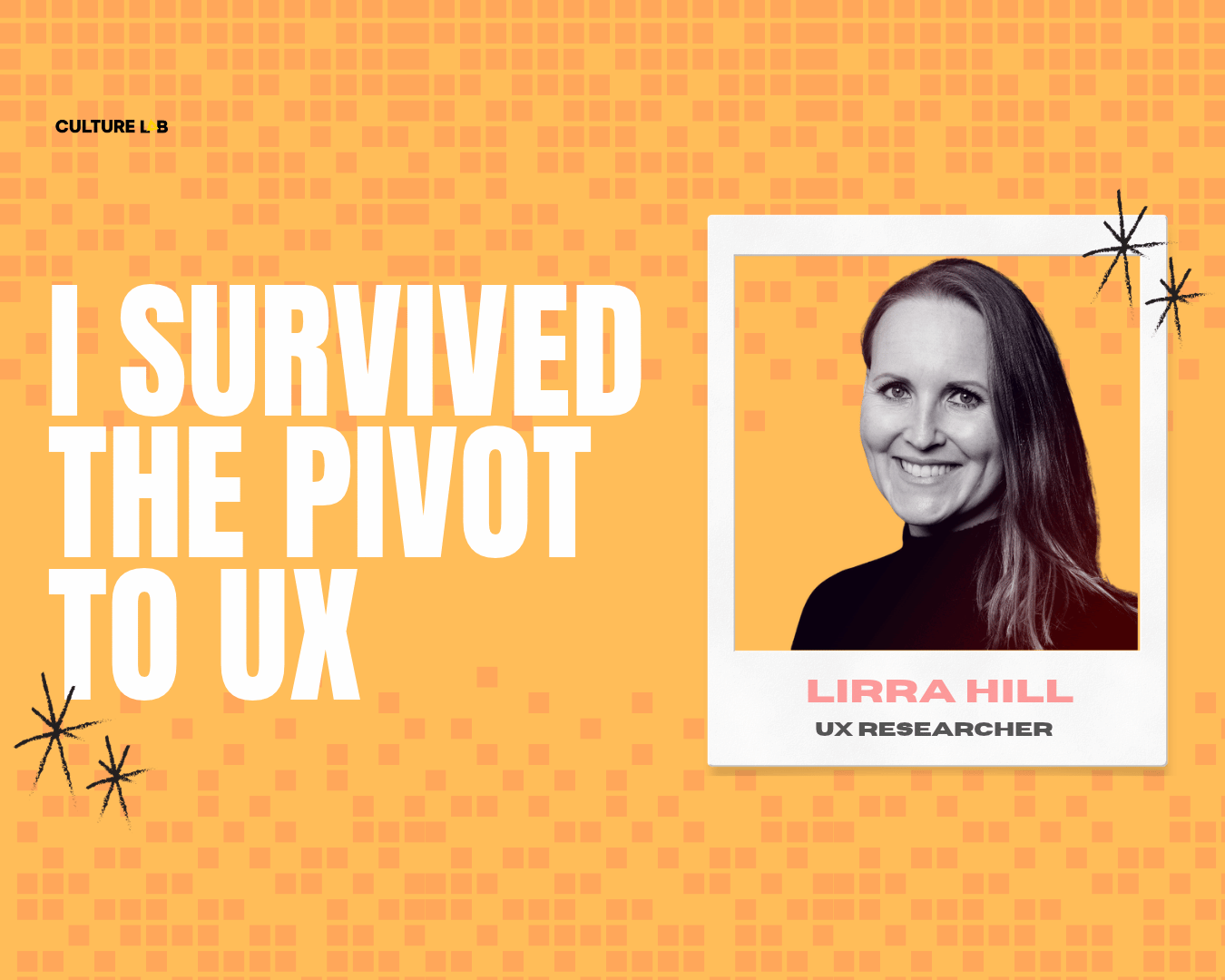



How Lirra Hill Survived the Pivot from Strategy to UX

A career is a jungle gym, not a ladder.
Cimira Crews
·
November 2, 2026

Lirra Hill, a 2011 VCU Brandcenter alum, has worked in advertising, innovation, consulting, and now UX research at Adobe. Talk about taking the scenic route! Her career didn’t follow a straight line, and honestly, that’s kind of the point.

‍
In our conversation, Lirra gets real about changing directions, figuring things out as she goes, and learning that just because you’re good at something doesn’t mean you have to do it forever. From navigating career uncertainty to realizing her strategy skills could take her somewhere entirely new, she reminds us that you don’t need a five-year plan for every plot twist. Sometimes, you just have to follow what interests you and see where it takes you.

‍

You went from brand strategy to innovation, consulting, and eventually UX research. How did you figure out what you wanted to do next?

Honestly, it was slow. The bigger picture is that I kept following the parts of my job that interested me, the things I felt suited me, and the work I loved most; for me, that was research.

‍
After Brandcenter, I went into innovation, which I really loved. I would have stayed in it longer, but life happened. I moved cities and couldn't find a job doing what I wanted to do, and I was a new mom at the time as well, so I went back into advertising. I was often following the people who inspired me as much as the work itself.

‍
Back then, we talked about these "jungle gym" career paths, and that's absolutely what mine has been. I'd follow one thing that interested me, then another, and sometimes circumstances would push me in a different direction.

‍
In the last few years, though, my choices have become more intentional. I wanted to get back into research and innovation consulting, so I found my way to a firm that combined traditional market research with consulting, innovation, and brand strategy. I really liked that mix of work. I also grew a lot and gained confidence in my research skills there.

‍
Before that, my research experience had been pretty scrappy. I'd interviewed people and written a discussion guide at Brandcenter, but I was learning a lot on the job. Suddenly, I was running focus groups for major brands, and I remember thinking, "Wow, I think I know what I'm doing? I don't know." Eventually, you do it enough times and realize that maybe you do know what you're doing.

‍
After moving to California, I was ready for something different. I'd learned a lot in consulting, but I was tired of the grind and wanted a better work-life balance. I explored client-side research, but I didn't want to manage vendors. I wanted to do the research myself, and UX offered a way to keep doing the work I loved in a new environment.

‍

You knew you wanted something different, but how did you navigate the uncertainty of getting there?

I think the hardest times were when I didn't know what my next step was going to be. There were definitely months when I wasn't working, or was just in the interview process. I'm sure a lot of recent graduates can sympathize with that.
There's so much uncertainty. You start questioning yourself: Am I ever going to get a job? Does anyone want to talk to me? Are any of these emails reaching anyone? Is any of this going to work?
That uncertainty has gotten a little easier to manage as I've gotten older and built more stability in my personal life, but it never completely goes away.

I think you can only control what you can control. You can put yourself out there, get your portfolio in great shape, keep reaching out for informational interviews, and continue networking. Eventually, something will work out, and it'll be the right time or the right conversation.

When you're on the other side of it, you also have to remember that people aren't living and breathing your job search the way you are. If someone doesn't respond to an email or a LinkedIn message, it doesn't automatically mean they don't care, they're not interested, or you're terrible. That's a reality check I try to keep in mind when I'm navigating uncertainty.

You have to give yourself some grace and recognize that not everything is a reflection of your worth or ability.

‍

How did you make the case that your strategy background could translate into a completely different field?

My resume wasn't primed for UX at all. I had done a lot of work in advertising, but employers were looking at my experience and wondering how it translated to technology.  I remember thinking, it's the same skill set; it's just a different vehicle for it.

‍
One of the opportunities that helped me bridge that gap was a short-lived role, and I wasn’t on the project for long, but it involved technology, which gave me something concrete to discuss during interviews. That portfolio piece demonstrated how I could take research and turn it into ideas for tech. Even though I'd only been on the project for a few weeks, I had enough experience with it to explain my contribution.

‍
I also think people sometimes underestimate how much of their existing experience they can bring into a new role. The ingredients are the same, and you already know how to do a lot of the work. The output might look a little different, but you're not necessarily starting from scratch.

‍
That applies to the kind of work you're doing at Brandcenter, too. Even if you're working on a product or platform that's unfamiliar to you, you're still a person in this world. You understand how people consume media, how they interact with brands, and what you might find interesting as a consumer. You can bring that perspective into your work.

‍

Now that you're working in UX research, what does the work actually look like, and how has your strategy background shaped the way you approach it?

I think one of the questions I'd ask someone trying to figure out their career is: What part of your projects do you actually love? What do you get the most value and gratification from?

‍
For me, it was always taking the raw materials, finding new ways into the problem, and turning a big mess of findings into something clean and clear. It's almost like making a huge meal and then cleaning the kitchen. You look around afterward, everything is in its place, and you can finally see what you've accomplished.

‍
My work in UX research lets me do that. Sometimes we're introducing a new feature and need to conduct interviews to figure out where the gaps are. Other times, we're trying to understand how people approach a product or experience and what would make it better.

‍
My background in strategy means I can contribute beyond the traditional boundaries of my role. I understand marketing, brand positioning, and what a feature or product release means for the overall brand. That strategic perspective is something I bring into my work, and it's become an important part of how I operate and also the relationships I’ve been able to cultivate at each stage of my career.

‍
In an agency environment, if something wasn't working, there could be a lot of pressure to redo it immediately, get approvals, and make sure the client was happy. In my current environment, I have more room to make decisions about the quality of the research and how we move forward.

‍
It’s important to remember research doesn't always produce some groundbreaking revelation. At Brandcenter, there's often this expectation that every insight has to be something nobody has ever thought of before. In reality, a lot of my work involves straightforward facts and observations.

‍

What have you learned along the way, and what would you tell a young strategist trying to find their footing?

Be honest about what you don't know. There have been knowledge and experience gaps at every stage of my career. When I've encountered something new, I've had to be willing to tell my coworkers or managers that I've never done it before and ask if they can support me through it.

I've never really had a problem being vulnerable. I think that's partly because I've looked for environments where I can be myself and where people aren't expecting perfection.

Maybe I've never written a particular type of research brief before. I'll ask to see an example. Maybe I've never conducted a certain type of study. I'll ask for tips, work closely with my manager, and get feedback. There's always room to learn, no matter where you are in your career.

I'd also tell young strategists that there's a balance between having a point of view and knowing when to let it go.

We want you in the industry; we want your voice and your opinions. That's why we're here, and that's why we've hired you. At the same time, workplaces have hierarchies and dynamics that you have to learn to navigate. You have to learn when to advocate for your perspective and when to accept that someone else is making the decision.

That can be difficult coming out of Brandcenter, where students often work alongside one another on relatively equal footing, but in the professional world, there are different levels of responsibility, experience, and decision-making authority. 

Remember that your insights are your creativity. When you're building a portfolio, tell the story of your research process. Talk about what you did, what you learned, and how you arrived at your recommendations. You don't necessarily need a portfolio full of flashy creative executions to demonstrate that you can think strategically.

I'm looking for strong writing, sharp observations, and the ability to read between the lines instead of simply restating facts. Especially now, when so much writing and synthesis can be generated by AI, strong human writing matters. This applies to everything, not just your portfolio. Your cover letter, your emails, and the way you introduce yourself all give people a sense of who you are.

There's a tendency to try so hard to be cool or different that the work starts to feel less authentic. I want to understand why your perspective is interesting or compelling.

Ultimately, you don't have to know exactly where your career is going to take you. Follow the work that interests you, be willing to learn, and give yourself room to change directions. You might find that the skills you've spent years developing are exactly what you need for something you haven't even tried yet.

‍

Editor’s Note: This conversation has been lightly edited for publication purposes.

‍

How Lirra Hill Survived the Pivot from Strategy to UX

Cimira Crews
·
November 2, 2026

A career is a jungle gym, not a ladder.

Lirra Hill, a 2011 VCU Brandcenter alum, has worked in advertising, innovation, consulting, and now UX research at Adobe. Talk about taking the scenic route! Her career didn’t follow a straight line, and honestly, that’s kind of the point.

‍
In our conversation, Lirra gets real about changing directions, figuring things out as she goes, and learning that just because you’re good at something doesn’t mean you have to do it forever. From navigating career uncertainty to realizing her strategy skills could take her somewhere entirely new, she reminds us that you don’t need a five-year plan for every plot twist. Sometimes, you just have to follow what interests you and see where it takes you.

‍

You went from brand strategy to innovation, consulting, and eventually UX research. How did you figure out what you wanted to do next?

Honestly, it was slow. The bigger picture is that I kept following the parts of my job that interested me, the things I felt suited me, and the work I loved most; for me, that was research.

‍
After Brandcenter, I went into innovation, which I really loved. I would have stayed in it longer, but life happened. I moved cities and couldn't find a job doing what I wanted to do, and I was a new mom at the time as well, so I went back into advertising. I was often following the people who inspired me as much as the work itself.

‍
Back then, we talked about these "jungle gym" career paths, and that's absolutely what mine has been. I'd follow one thing that interested me, then another, and sometimes circumstances would push me in a different direction.

‍
In the last few years, though, my choices have become more intentional. I wanted to get back into research and innovation consulting, so I found my way to a firm that combined traditional market research with consulting, innovation, and brand strategy. I really liked that mix of work. I also grew a lot and gained confidence in my research skills there.

‍
Before that, my research experience had been pretty scrappy. I'd interviewed people and written a discussion guide at Brandcenter, but I was learning a lot on the job. Suddenly, I was running focus groups for major brands, and I remember thinking, "Wow, I think I know what I'm doing? I don't know." Eventually, you do it enough times and realize that maybe you do know what you're doing.

‍
After moving to California, I was ready for something different. I'd learned a lot in consulting, but I was tired of the grind and wanted a better work-life balance. I explored client-side research, but I didn't want to manage vendors. I wanted to do the research myself, and UX offered a way to keep doing the work I loved in a new environment.

‍

You knew you wanted something different, but how did you navigate the uncertainty of getting there?

I think the hardest times were when I didn't know what my next step was going to be. There were definitely months when I wasn't working, or was just in the interview process. I'm sure a lot of recent graduates can sympathize with that.
There's so much uncertainty. You start questioning yourself: Am I ever going to get a job? Does anyone want to talk to me? Are any of these emails reaching anyone? Is any of this going to work?
That uncertainty has gotten a little easier to manage as I've gotten older and built more stability in my personal life, but it never completely goes away.

I think you can only control what you can control. You can put yourself out there, get your portfolio in great shape, keep reaching out for informational interviews, and continue networking. Eventually, something will work out, and it'll be the right time or the right conversation.

When you're on the other side of it, you also have to remember that people aren't living and breathing your job search the way you are. If someone doesn't respond to an email or a LinkedIn message, it doesn't automatically mean they don't care, they're not interested, or you're terrible. That's a reality check I try to keep in mind when I'm navigating uncertainty.

You have to give yourself some grace and recognize that not everything is a reflection of your worth or ability.

‍

How did you make the case that your strategy background could translate into a completely different field?

My resume wasn't primed for UX at all. I had done a lot of work in advertising, but employers were looking at my experience and wondering how it translated to technology.  I remember thinking, it's the same skill set; it's just a different vehicle for it.

‍
One of the opportunities that helped me bridge that gap was a short-lived role, and I wasn’t on the project for long, but it involved technology, which gave me something concrete to discuss during interviews. That portfolio piece demonstrated how I could take research and turn it into ideas for tech. Even though I'd only been on the project for a few weeks, I had enough experience with it to explain my contribution.

‍
I also think people sometimes underestimate how much of their existing experience they can bring into a new role. The ingredients are the same, and you already know how to do a lot of the work. The output might look a little different, but you're not necessarily starting from scratch.

‍
That applies to the kind of work you're doing at Brandcenter, too. Even if you're working on a product or platform that's unfamiliar to you, you're still a person in this world. You understand how people consume media, how they interact with brands, and what you might find interesting as a consumer. You can bring that perspective into your work.

‍

Now that you're working in UX research, what does the work actually look like, and how has your strategy background shaped the way you approach it?

I think one of the questions I'd ask someone trying to figure out their career is: What part of your projects do you actually love? What do you get the most value and gratification from?

‍
For me, it was always taking the raw materials, finding new ways into the problem, and turning a big mess of findings into something clean and clear. It's almost like making a huge meal and then cleaning the kitchen. You look around afterward, everything is in its place, and you can finally see what you've accomplished.

‍
My work in UX research lets me do that. Sometimes we're introducing a new feature and need to conduct interviews to figure out where the gaps are. Other times, we're trying to understand how people approach a product or experience and what would make it better.

‍
My background in strategy means I can contribute beyond the traditional boundaries of my role. I understand marketing, brand positioning, and what a feature or product release means for the overall brand. That strategic perspective is something I bring into my work, and it's become an important part of how I operate and also the relationships I’ve been able to cultivate at each stage of my career.

‍
In an agency environment, if something wasn't working, there could be a lot of pressure to redo it immediately, get approvals, and make sure the client was happy. In my current environment, I have more room to make decisions about the quality of the research and how we move forward.

‍
It’s important to remember research doesn't always produce some groundbreaking revelation. At Brandcenter, there's often this expectation that every insight has to be something nobody has ever thought of before. In reality, a lot of my work involves straightforward facts and observations.

‍

What have you learned along the way, and what would you tell a young strategist trying to find their footing?

Be honest about what you don't know. There have been knowledge and experience gaps at every stage of my career. When I've encountered something new, I've had to be willing to tell my coworkers or managers that I've never done it before and ask if they can support me through it.

I've never really had a problem being vulnerable. I think that's partly because I've looked for environments where I can be myself and where people aren't expecting perfection.

Maybe I've never written a particular type of research brief before. I'll ask to see an example. Maybe I've never conducted a certain type of study. I'll ask for tips, work closely with my manager, and get feedback. There's always room to learn, no matter where you are in your career.

I'd also tell young strategists that there's a balance between having a point of view and knowing when to let it go.

We want you in the industry; we want your voice and your opinions. That's why we're here, and that's why we've hired you. At the same time, workplaces have hierarchies and dynamics that you have to learn to navigate. You have to learn when to advocate for your perspective and when to accept that someone else is making the decision.

That can be difficult coming out of Brandcenter, where students often work alongside one another on relatively equal footing, but in the professional world, there are different levels of responsibility, experience, and decision-making authority. 

Remember that your insights are your creativity. When you're building a portfolio, tell the story of your research process. Talk about what you did, what you learned, and how you arrived at your recommendations. You don't necessarily need a portfolio full of flashy creative executions to demonstrate that you can think strategically.

I'm looking for strong writing, sharp observations, and the ability to read between the lines instead of simply restating facts. Especially now, when so much writing and synthesis can be generated by AI, strong human writing matters. This applies to everything, not just your portfolio. Your cover letter, your emails, and the way you introduce yourself all give people a sense of who you are.

There's a tendency to try so hard to be cool or different that the work starts to feel less authentic. I want to understand why your perspective is interesting or compelling.

Ultimately, you don't have to know exactly where your career is going to take you. Follow the work that interests you, be willing to learn, and give yourself room to change directions. You might find that the skills you've spent years developing are exactly what you need for something you haven't even tried yet.

‍

Editor’s Note: This conversation has been lightly edited for publication purposes.

‍

See More by

Cimira Crews

→