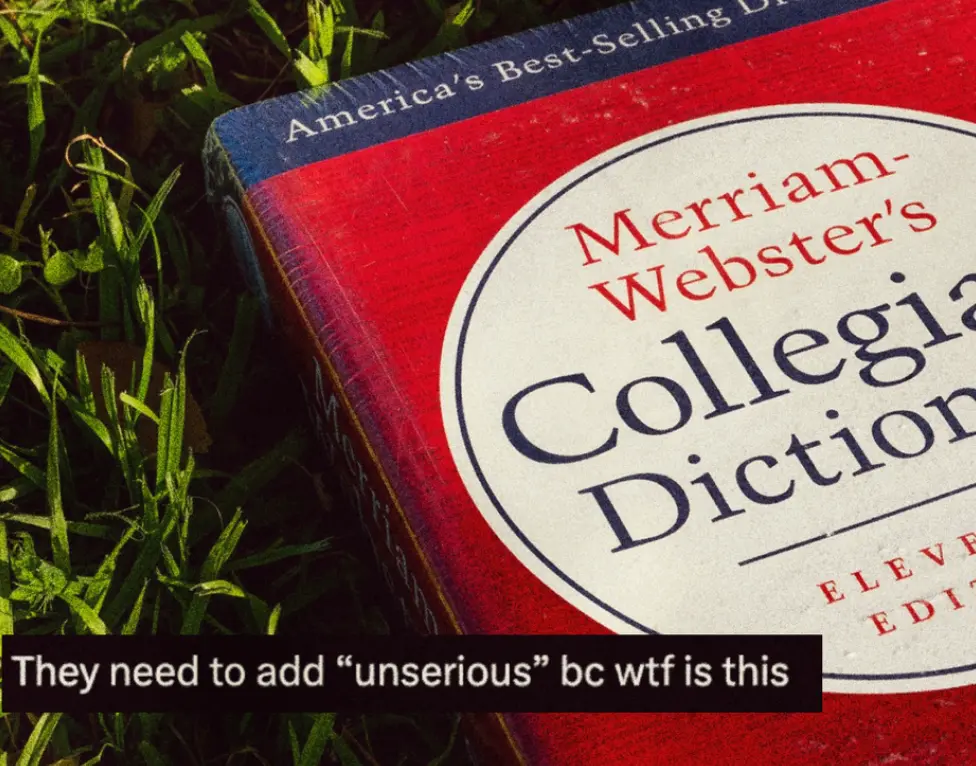
Merriam-Webster adapts to culture. Why are people crashing out?

‘Looksmaxxing’ being put into the dictionary won’t destroy the English language. I promise.
Kennon Cummings
·
September 24, 2026

This past week, the Merriam-Webster Dictionary’s online site received one of its largest updates in recent history, announcing 1,400 new words and definitions to reflect the world’s constantly evolving use of language. Newcomers include the dreadful 'Sunday Scaries', the much more enjoyable 'cake pop', and modern-day philosophies such as our newfound reliance on 'copium'.

“The new entries reflect words and meanings that have demonstrated widespread use over time, offering a window into the world today.” —Merriam-Webster

Unsurprisingly, the internet had things to say about the update, with many naysayers criticizing the organization for adding ‘needless slang’ to a directory of much more ‘formal’ words….

…Which I think is pretty stupid.

SHOCKING: LANGUAGE EVOLVES OVER TIME

Why shouldn’t a dictionary reflect its own population? It’s not as if we’ve hit a point in history where we’ve solidified every word that’ll ever be invented. Merriam-Webster’s inclusion of ‘slang’ words isn’t a new phenomenon, either. The organization is well known for documenting slang throughout history. Just because it’s new doesn’t make it any less important— don’t be such a galoot about linguistic preservation!

CONSERVATION IS THE NEW AURA

Look, I’m not ignoring the fact that rickrolling being added to the dictionary is admittedly a little funny, but if a brand like Merriam-Webster simply planted its feet in the ground and stubbornly ignored our ‘silly’ new words, we'd leave so much history unaccounted for. Situations like this really emphasize how important preservation is not just for a brand, but for history as a whole. Maybe it seems a little goofy to immortalize these words in the short term, but who knows? Maybe some unsuspecting Brandcenter student from the class of 2086 will one day have to write a Culture Lab article on the ancient history of the word rizz— a situation in which Merriam-Webster will loyally be by their side.

Merriam-Webster adapts to culture. Why are people crashing out?

Kennon Cummings
·
October 4, 2026

‘Looksmaxxing’ being put into the dictionary won’t destroy the English language. I promise.

NEW WORDS ADDED: GLOW-UP OR FLOP?

This past week, the Merriam-Webster Dictionary’s online site received one of its largest updates in recent history, announcing 1,400 new words and definitions to reflect the world’s constantly evolving use of language. Newcomers include the dreadful 'Sunday Scaries', the much more enjoyable 'cake pop', and modern-day philosophies such as our newfound reliance on 'copium'.

“The new entries reflect words and meanings that have demonstrated widespread use over time, offering a window into the world today.” —Merriam-Webster

Unsurprisingly, the internet had things to say about the update, with many naysayers criticizing the organization for adding ‘needless slang’ to a directory of much more ‘formal’ words….

…Which I think is pretty stupid.

SHOCKING: LANGUAGE EVOLVES OVER TIME

Why shouldn’t a dictionary reflect its own population? It’s not as if we’ve hit a point in history where we’ve solidified every word that’ll ever be invented. Merriam-Webster’s inclusion of ‘slang’ words isn’t a new phenomenon, either. The organization is well known for documenting slang throughout history. Just because it’s new doesn’t make it any less important— don’t be such a galoot about linguistic preservation!

CONSERVATION IS THE NEW AURA

Look, I’m not ignoring the fact that rickrolling being added to the dictionary is admittedly a little funny, but if a brand like Merriam-Webster simply planted its feet in the ground and stubbornly ignored our ‘silly’ new words, we'd leave so much history unaccounted for. Situations like this really emphasize how important preservation is not just for a brand, but for history as a whole. Maybe it seems a little goofy to immortalize these words in the short term, but who knows? Maybe some unsuspecting Brandcenter student from the class of 2086 will one day have to write a Culture Lab article on the ancient history of the word rizz— a situation in which Merriam-Webster will loyally be by their side.
See More by

Kennon Cummings

→